Most of us do not decide to stop being thankful. It happens quietly. A prayer gets answered, we breathe out, and by the following week we are already worried about the next thing. The answer that once felt like a miracle becomes part of the furniture.
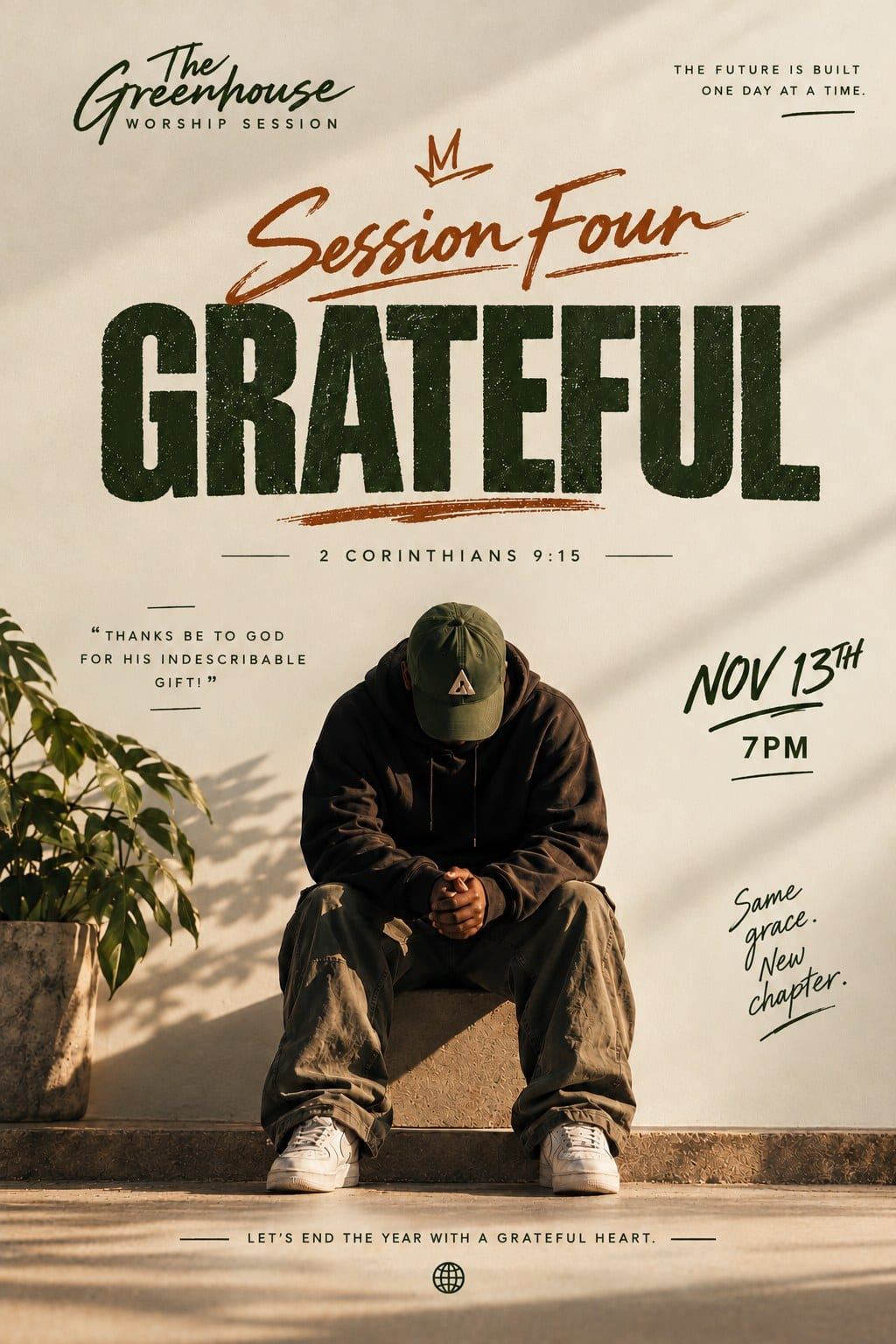
That is why Session 04 of The Green House W.S, held on 13 November 2026 at Chrisco Donholm Grounds in Nairobi, carries a one word theme: Grateful. Our anchor scripture is 2 Corinthians 9:15, where Paul writes, "Thanks be to God for his indescribable gift!" As a worship community in Nairobi that only gathers quarterly, we wanted to close the year by looking back before we look ahead.
What is spiritual amnesia?
Spiritual amnesia is our name for a very ordinary problem: forgetting what God has already done for us. It is not unbelief. It is not rebellion. It is simply a short memory.
Scripture treats this as a real danger. In Deuteronomy 8, Israel is warned that once they have eaten and are satisfied, built good houses and settled down, they must be careful not to forget the Lord. Psalm 103:2 puts it as an instruction to the soul: "forget not all his benefits." The Bible would not keep telling us to remember if forgetting did not come so naturally.
The trouble with spiritual amnesia is what it takes from us. When we forget, we lose the moment to pause, reflect and simply be grateful. And a faith with no memory has to start from zero every time life gets hard.
What gets in the way of gratitude?
It helps to be honest about the hurdles. A few that many of us recognise:
- Hurry. Nairobi does not slow down for anyone. When every day is a race from one deadline to the next, there is no room to notice what went right.
- Comparison. It is hard to thank God for your portion while studying someone else's. What we have starts to look small the moment we measure it against another person's life.
- Familiarity. Health, a job, a friend who picks up the phone, breath itself. The gifts we receive every day are the ones we stop seeing.
- Unanswered prayers. One request that is still waiting can drown out ten that were granted. Disappointment is loud, and gratitude is usually quiet.
- Pain. Some seasons are simply heavy, and being told to "just be thankful" can feel like being asked to pretend.
In Luke 17, Jesus heals ten men with leprosy. All ten are healed. Only one turns back to say thank you. The other nine were not wicked. They were just on their way to the next thing.
How can we be grateful in every season?
Paul's instruction in 1 Thessalonians 5:18 is to give thanks in all circumstances. He does not say for all circumstances. Gratitude is not calling a hard thing good. It is refusing to let a hard thing erase everything else that is true.
Paul also says, in Philippians 4, that he learned to be content whether he had plenty or was in need. Contentment was not his personality. It was a practice. Here are a few ways to practise it:
- Name things specifically. "Thank you for everything" is easy to say and easy to forget. "Thank you that the school fees were paid in September" is a memory you can return to.
- Keep a record. In Joshua 4, Israel stacks twelve stones by the Jordan so that their children will one day ask what they mean. Write things down. A notebook or a note on your phone does the same job as those stones.
- Say it out loud. Gratitude grows when it is shared. Telling a friend what God did for you strengthens their faith and fixes it in your own memory.
- Start with the gift that does not change. This is where 2 Corinthians 9:15 takes us. Circumstances rise and fall, but the gift Paul calls indescribable, Christ himself, has already been given. On the days when nothing else comes to mind, that one is still true.
Habakkuk ends his book with empty fields and no cattle in the stalls, and still says he will rejoice in the Lord. That is not denial. That is a man who remembered who God is when the evidence around him was thin.
Why we are ending the year this way
The end of a year invites a particular kind of stocktaking: what we achieved, what we missed, what we want next. There is a place for that. But before the plans and the resolutions, we want to do something simpler, which is to stop and say thank you.
So here is a small invitation, whether or not you were in the room with us. Before this week ends, write down five things God has done for you this year. Be specific. Then tell one person about one of them.
If you would like to worship and reflect with us in person, The Green House W.S is a cross-church Christian community in Nairobi that meets once a quarter. You can read about Session 04, see upcoming sessions, or find out how to get involved.
Thanks be to God for his indescribable gift.